• Home
  • Workshops
    • Bow Immersion
    • Immersion Registration
    • Workshop Registration
  • Bows
    • Custom Bow Order Form
  • Arrows
  • Info
    • How to String Your Bow
    • About Us
    • Yew Tree
    • FAQ
    • Links
  • Gallery
  • Contact Us
  • Blog

Workshops

_Build Your Own Wooden Bow
Reconnect to time honoured skills

Join bowyer Jamie MacDonald and learn the art of building a traditional wooden bow. Jamie is versed in many different styles (longbow, flatbow, recurve, etc.) and will help you craft an exceptional and functional bow.
All materials - including a seasoned pacific yew stave - and tools are included.

Pacific Yew is the ultimate bow wood because of the uniqueness of the sapwood/heartwood combination. The yew tree is and has been prized all over the world for bows. The sapwood excels under tension, while the heartwood's gift is strength under compression. This combination is alike to a natural lamination.

Register here for a bow workshop!

During this three day course you will:
Select a yew wood stave
    These staves are harvested with respect from local forests. Ideal trees split near the base
    and create multiple leaders. This allows a leader to be harvested without killing the whole
    tree. These often have one side that are clear from branches, which means less knots to
    work around. Branches are also harvested if the tree is large enough. Every stave offered
    in the workshops has solid bow potential. Teaching includes how to work around
    individual characteristics presented.
Process stave
    Processing starts with debarking the stave using knives and scrapers. Once through the
    outer bark and cambium the outer sapwood is revealed. On this you will draw the outline
    for your bow. Using a hatchet, wood is removed to the rough outline. The next step is
    using a ferrier`s rasp to work down until a long tillering string can be put on.
Tiller bow
    The tillering process is when the bow is being placed on a tillering stick - basically a piece
    of wood which holds the strung bow, where a pulley and weight are attached. You can pull
    the rope, stand back, look at the shape the bow is taking, see how heavy and at what length
    the pull is. This is a critical process where you will receive support in understanding
    specifically where to be working the bow further. Scrapers are also used in this process
    when the wood needs smaller adjustments.
Flemish twist bowstring
    This is taught as you move from a long to a short tiller string. It uses a special jig with
    multiple strings spliced and cordaged together.
Finishing
    Once the bow has achieved its final pull/weight combination it can be sanded. Finishing
    options after this point include shellac, true oil, tongue oil, or a polyurethane depending
    on what you like or a looking to do with the bow (and what kind of maintenance you
    want to keep up with). At this point a handle may be put on as well (or you can leave the
    bow with a wood handle). Leather/suede is most common with perhaps some padding
    underneath.


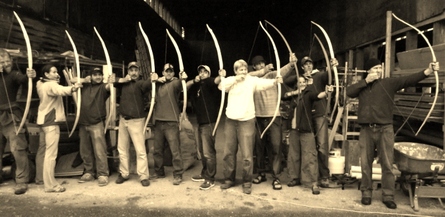
_Participants have ranged in age from 8 - 73. Want to see what gets created? Check out students wooden bows for a few examples.

Or visit: http://www.flickr.com//photos/woodlandworkshop/sets/72157627634607871/show/
Wonderful pictures from a workshop on Salt Spring Island with our friend Grant Callegari at Woodland Workshop.
Picture

Locations & Dates
(January-June 2012)

_Powell River $295
    June 22-24
Victoria $395
   More dates coming later in 2012
Comox Valley $345
    June 15-17 
Vancouver/Lower Mainland $395
    May 19-21: Full

                9am-6pm daily
_
Picture
Picture


If you are interested in hosting a workshop in your area or have any further questions about the workshops, please contact us. 
Traditional Yew Bows . . . . . . info@ravenbeak.com . . . . . . Ravenbeak Natureworks . . . . . . 604.413.2209 . . . . . . Bow Building Workshops